The Gowrie Victoria website is not compatible with Internet Explorer. Please use a modern browser such as Chrome, Firefox, Edge, or Safari for the best experience.
Purpose
The purpose of this policy is to set out a framework for Gowrie Victoria’s educational programs for children attending its services.
Scope
This policy applies to all staff members, volunteers, students on placement and contractors/labour hire employees of Gowrie Victoria.
Policy Statement
Gowrie Victoria will meet the learning and developmental strengths, needs and interests of each child being educated and cared for at its services. The educational programs will be:
- based on an approved learning framework (National Early Years Learning Framework0 and/or the Victorian Early Years Learning and Development Framework)
- based on the guiding principles of the National Quality Framework which state:
- Australia’s Aboriginal and Torres Strait Islander cultures are valued
- the rights and best interests of the child are paramount
- children are valued as successful, competent and capable learners
- equity, inclusion and diversity is fundamental
- the role of families plays a significant role in decision making in relation to their child
- informed by understandings of:
- each child in the context of their family, culture and community
- opportunities to engage with learning environments and the people within these environments
All educational programs and experiences need to be underpinned by:
- Gowrie Victoria’s purpose and values
- Gowrie Victoria’s early learning philosophy
- individual service Statements of Intent
- UN Convention on the Rights of the Child
- contemporary evidence-based research
- ECA’s Code of Ethics
- Educators should ensure that they have a thorough understanding of Gowrie Victoria’s philosophy and apply it in their curriculum decision making and pedagogical
Integrated teaching and learning
Gowrie Victoria considers all children to be capable and competent learners.
Learning is a continuous process. Opportunities for learning should be integrated into children’s rhythms, interactions and experiences, regardless of whether they are planned or spontaneous. It involves educators and children being actively engaged throughout these opportunities for learning.
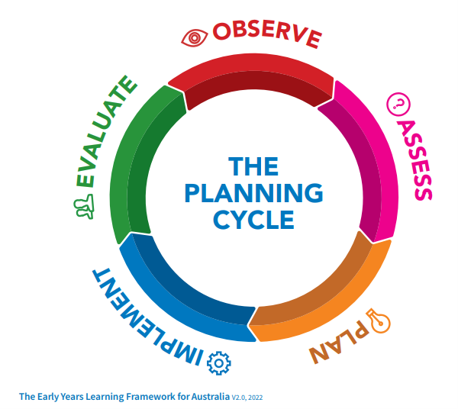
Gowrie Victoria’s educational programs, and the practices of its educators, must be centred on the best interests of each child. Educators should use planning and assessment cycle, in conjunction with critical reflection to ensure that each child is learning and achieving their potential. Educators will apply strategies to support sustained shared interactions with children through play based encounters as well as more focused learning opportunities.
Collaboration with families
Gowrie Victoria recognises that working in partnership with children’s families, and making decisions about children collaboratively with families, are essential to all children’s learning, development and well-being.
Collaboration with other professionals
Gowrie Victoria will also work with or other professionals to support children’s learning, wellbeing and development.
Richness of learning experiences
Gowrie Victoria will ensure that children are consistently offered a range of rich, play-based learning experiences, including language and literature, mathematics and science, sensory, dramatic and imaginative, visual arts, music and movement, physical, self-help, and environmental awareness and responsibility.
Gowrie Victoria considers all rhythms and transitions including mealtimes, rest, toileting, and tidying up as valuable learning opportunities. These times of the day are language rich and involve decision making by both children and adults.
Education programs need to be linked to and supported by resources, materials and equipment which allow for multiple use, develop child agency and autonomy, and encourage play-based learning and exploration as part of a community of learners.
Place of learning
Gowrie Victoria supports a learning approach which allows children to explore indoor and outdoor spaces freely in all weather. It considers every space to be a learning environment. By adhering to this principle of ‘any child, any classroom, any time’, Gowrie Victoria ensures that its education programs and practices are not limited by location within each of its services and educators plan accordingly for all learning spaces.
This principle encourages interactions between children and educators from across the service and is not limited to designated room groups and promotes interaction with the natural environment.
Sustainability
Gowrie Victoria views sustainability as multidimensional including environmental, social and economic understandings. There is a strong focus on children developing an understanding of local and global citizenship, rights and responsibilities of being active members of a community. Children are involved in decision making that affects them, those around them, including all living things. Conservation and care of Country is an integral part of the planning and delivery of the educational programs.
Aboriginal and Torres Strait Islander perspectives
Gowrie Victoria acknowledges Aboriginal and Torres Strait Islander people as the First Peoples of this nation and the Traditional Owners of the land on which we teach and learn. We recognise their continuing connection to culture, land, water and community. We are committed to learning with and from our First Peoples’ ways of knowing and being.
Child safety
Gowrie Victoria is committed to being a child safe organisation. Gowrie Victoria considers that the physical, psychological and cultural safety of children is fundamental for their learning and development. Gowrie Victoria ensures all children are actively supported to participate in our educational programs and the programs are responsive to children’s contributions. Children’s perspectives are privileged through our programs where children can express their views, participate in decision-making and contribute in meaningful ways.
Technology
Gowrie Victoria recognises that digital technology is part of the environment that children and adults engage with. Children, with the support and supervision from educators use laptops, tablets, cameras, projectors, Go-Pros and other devices to research their wonderings and demonstrate their findings. Gowrie Victoria does not use electronic platforms for documenting children’s learning. This decision has been made to make learning visible and accessible to children so that they can scaffold their own learning in the program.
Gowrie Victoria follows the principles set out in ECA’s Statement on Young Children and Digital Technologies in its principles set out in ECA’s Statement on Young Children and Digital Technologies in its pedagogical practices.
Critical reflection
Gowrie Victoria recognises the importance and power of critical reflection for improving its educational programs and for ensuring that each child’s education, development, and wellbeing is fully supported. A culture of regular reflection helps Gowrie Victoria to set and review expectations, to improve its practices, all with the ultimate goal of advancing children’s learning, development and well-being.
Gowrie Victoria facilitates formal community of practice groups to engage in regular reflection, evaluation and modification of teaching and learning at all its services. Community of practice groups can also develop new areas of the teaching program, including but not limited to; Indigenous culture and history, environmental education, coaching, documentation, inclusion and diversity, and service specific areas of interest.
Authorisation
Approved by the Chief Executive Officer
Name Susan Anderson
Signature 
Date 1 September 2023
References
| NQS Quality Area | QA1 Educational program and practice |
| Policy Status | Best practice |
| Related Procedures | Cultural Awareness and Inclusion procedure Supervision Procedure |
| Policies Referenced | Children’s Relationship policy Early Learning Staff policy Family and Community Engagement policy |