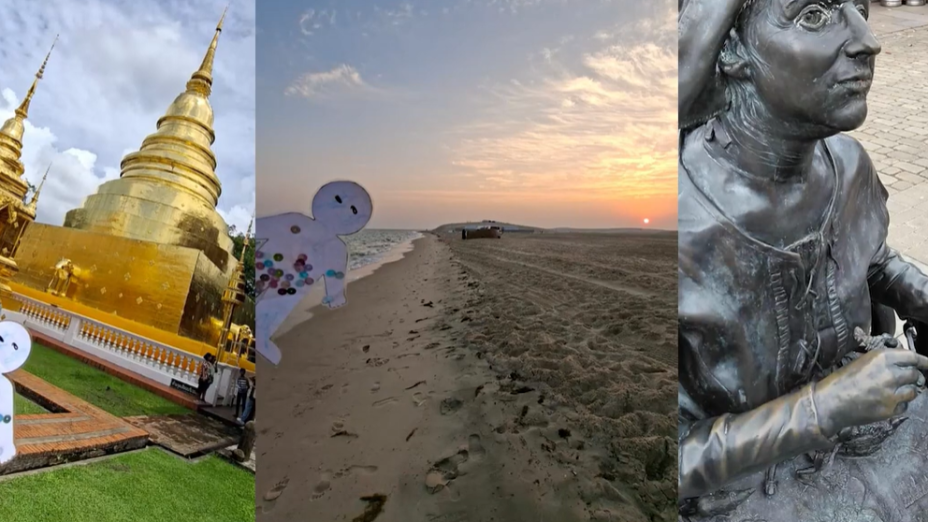
In August, the Rainbow Lorikeet children chose to read Flat Stanley by Jeff Brown. This simple decision has evolved and evolved, into a worldwide community learning experience. The book—about a boy who is flattened by a cupboard falling on him and then travels the world through envelopes—quickly had the children interested in the idea of exploring the world.
The educators noticed the way that the story fostered thinking around how people and ideas travel, how mail can connect communities, and how diversity and difference can bring us together. The children were fascinated by Stanley’s ability to be posted around the world, and this curiosity came to life with the creation of the children’s own Stanleys. The children began exploring how thin Stanley needed to be to fit under the door—with the idea that if he could fit under the door, he would fit into the post box.
Co-constructing the project
Discussion unfolded naturally as the children explored ideas about letters, envelopes, travel and the continents. They shared stories about people they knew in other parts of the world and wondered aloud where their Stanley might go if they could send them on an adventure.
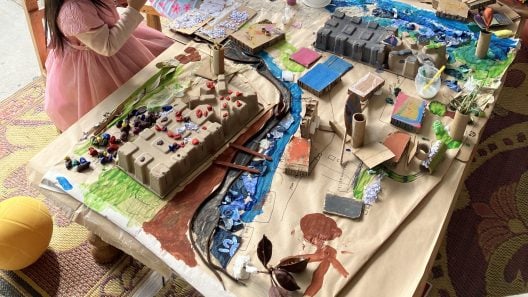
Together, they created a world map which was drawn, painted and labelled by children and educators. Each child then designed their own Stanley, decorating it with great care and taking it home with a blank envelope, a stamp and a letter written by the whole group. Families were invited to post their character to any destination they chose, with the intention that no two characters would travel to the same place.
The children co-authored the letter, ensuring Stanley’s voice reflected their ideas about safety, adventure and connection:
‘Hi. My name is Flat Stanley. I like to go on adventures—you could take me to the bakery, the beach, the pool, the zoo or the park. I get scared of strangers so keep me safe, you could put me in your bag or pocket. When we go on adventures, please send me and some photos to 40 Court Street, Yarraville, 3013, or back to the family who sent me to you. If it’s possible, you could send me to another destination. I need to be back home by Christmas so please post me by November at the latest.’
Thank you for looking after Stanley, love from the Room 6 Rainbow Lorikeets
This project organically invited collaboration, with children discussing the adventures they’d been on and places they’d visited or have family or friends living. For ECT Rosie, she was impressed with the level of engagement. “In all my years working in early childhood, this has been the thing where I’ve seen the most parent participation,” she says, “the parents have been so eager to be involved, to extend the learning that their child is gaining here”.
Families have embraced the project, getting in contact with friends and family sending Stanleys to their home countries and sharing languages and cultural knowledge, adding further depth to the children’s learning.
Learning emerging from the adventures
As letters and photos began arriving back at the service, the inquiry expanded in new directions. Children were invited to share their Stanley’s travels with the group. These presentations became multi-modal moments where children shared through verbal communication, videos and photos, music and movement—even documenting their learning through experiences with the floorbook, wall display and use of a GoPro.
As the children shared about the travels of the Stanley’s, learning took place around a range of topics—about different languages, climates, cultures and ways of being. One family sent their Stanley to the desert in Doha, sparking discussions about climate, landforms and seasons. The children compared desert environments in Qatar to those in Australia, recognising that different continents can have similar features. The children even became interested in volcanos, researching and wondering alongside educators if there are volcanoes on each continent.
A community-wide project
By December, 5 out of the 7 continents had been reached. Stanleys had travelled across more than 13 countries, and 5 states or territories within Australia. Each location brought new excitement, ideas and questions “How cold is it there?”, “Why does their writing look different?”, “Do they have parks like ours?”, “Why is the sky a different colour?”
This inquiry has woven into all elements of the program, strengthening relationships with families, connecting the children to their broader communities, and extending their thinking in meaningful, authentic ways. The project continues to evolve, with children now considering where Stanley shouldgonext, how to keep him safe, and what he might still need to learn.
Reflective questions:
How can I support children to reflect on what they have learned, and what they still hope to discover next?
What strategies can I use to help books or stories be a starting point for meaningful conversations or learning with children?
How can I invite families or friends into learning experiences in ways that deepen children’s understanding of the world?
How can I help children make sense of similarities and differences between cultures, climates or languages?
How can I model curiosity myself by researching alongside children when questions arise?
Explore Related News
Discover more ideas, stories and sector insights
Explore more news, stories and updates from across Gowrie Victoria, including insights from our early learning communities, professional learning, training and sector partnerships.
At Gowrie Docklands Kindergarten (GDK), children from one group had begun building their own Melbourne landscape, and it became the starting point for another group's exploration of what Melbourne means to them.
Senior secondary students from 13 government schools spent five weeks finding out what a career in early childhood education looks like day to day, through the second phase of the Introduction to Early Childhood for School Students program.
In July, a child in the Room 1 at our Gowrie Docklands Kindergarten site asked the educators why they can’t have real fire at the service. Rather than shutting the idea down, educators used it as a starting point for a longer project.
Earlier this year our Carlton Learning Precinct (CLP) service received a Victorian School Building Authority grant to address acoustic issues in the outdoor areas and the kitchen corridor, where excessive noise had made it challenging for our children and educators to communicate.
Wednesday 2 September was Early Childhood Educators’ Day, and teams across our services received many lovely and kind messages from children and their families thanking our educators for all that they do.
The Gowrie Victoria website is not compatible with Internet Explorer. Please use a modern browser such as Chrome, Firefox, Edge, or Safari for the best experience.