At Gowrie, we are committed to supporting our people to build their professional identities, engage in further learning, and more. For Hannah Fruin, Carlton North’s Early Learning Manager, this support meant that she was recently able to engage in a research project with academics from England and Turkey.
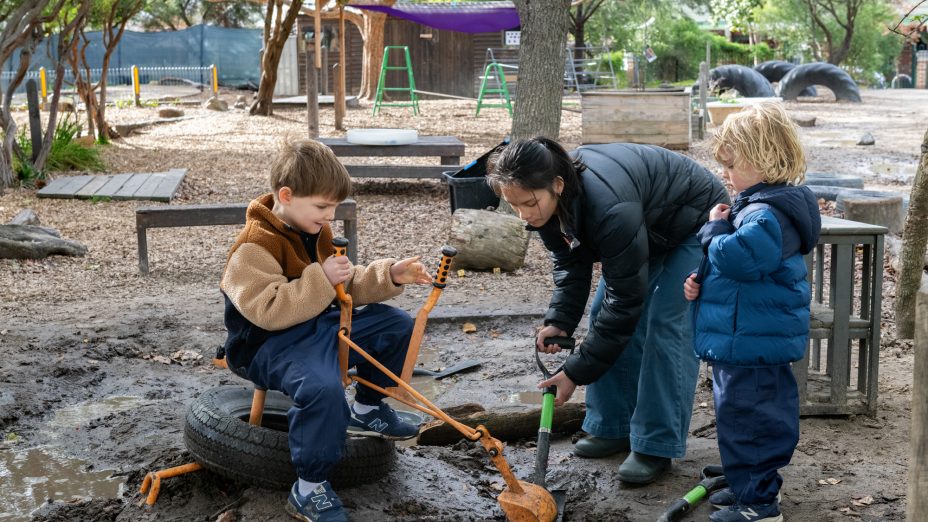
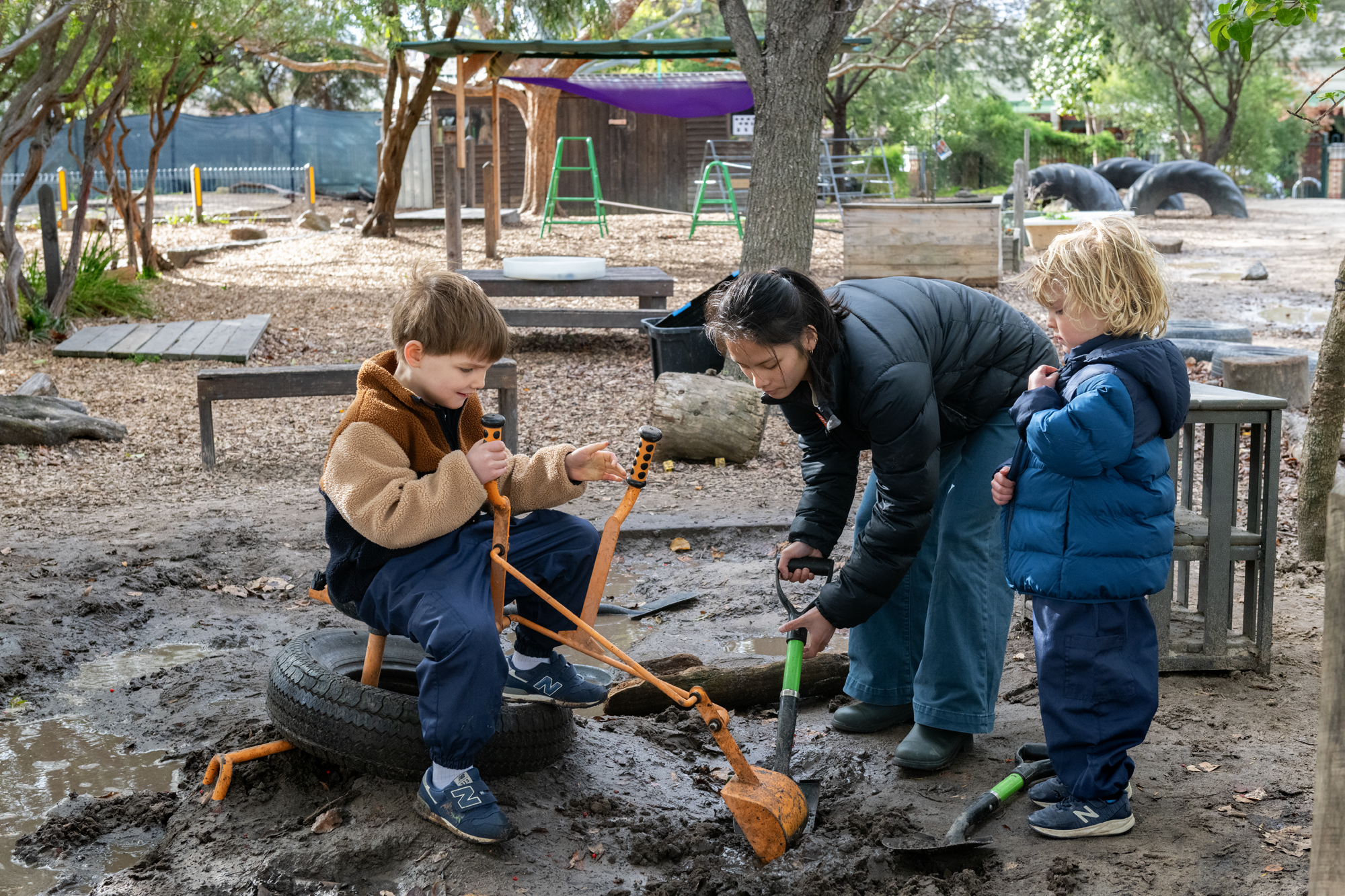
The wonder and research behind muddy play
Hannah has long had an interest in outdoor environments and how they impact play, learning and development. Her journey with research began in 2017 while completing her Master of Education: Culture, Language and Identity in London.
As an early childhood teacher, she was consistently drawn to the wonder she observed when children engaged with mud. This led her to choose the benefits of muddy play as the focus of her thesis. “I was always really drawn to this and passionate about it as a teacher,” Hannah recalls. “I quickly realised that there were vastly different perceptions of muddy play held by children, educators, and parents.”
Her research uncovered a tension. On one hand, many children appeared to be naturally drawn to the tactile, sensory, and unstructured possibilities of mud. On the other, some children appeared apprehensive or avoidant of playing with mud. For Hannah, this led her to ponder if the concerns of adults often acted as a barrier. Comments like a parent saying, “Be careful of your new shoes,” could illustrate a subtle, yet powerful, inhibition that could impact how a child interacted with the outdoor space for the entire day.
The study also highlighted cultural differences in concerns regarding health and cleanliness, with some staff confidently joining children in the mud pit—shoes off—while others remained more hesitant.
After her Master’s, Hannah and a professor at Goldsmiths College, University of London, recognised a gap in the existing literature. “There wasn’t much out there about the fundamental benefits of muddy play,” she notes. They refined the research, leading to its publication in the esteemed American journal Young Children in 2019.
Shaping identity through outdoor play
The muddy play research paved the way for Hannah’s next study. Keeping in touch with her former colleague, Dr. Betty Liebovich, and connecting with Dr. Yasin Ozturk and Dr Merve Gangal, Hannah was able to collaborate on a shared international research project in 2023.
The team collected data across Australia, England, and Turkey, interviewing pre-service teachers to explore their perceptions of outdoor play and how their personal views shaped their developing professional identities.
For Hannah, one finding stood out in the Australian context—the prevalence of children’s connection to Country and the inclusion of First Nations perspectives. This deep appreciation for the land was far more evident in the Australian interviews compared to those conducted in England and Turkey. Australian participants frequently discussed being outdoors in their own childhoods, engaging in activities such as camping, or going to the beach, suggesting that there was an innate cultural value placed on the natural environment—one which teachers felt mindful about embedding in their teaching.
Across all contexts, it was clear that pre-service teachers accepted and appreciated the importance of taking children outside and viewing the outdoor environment as a legitimate learning environment. From an English perspective, despite less predictable weather, the importance of time outside was also widely accepted.
The gaps between theory and practice
While the appreciation for outdoor learning appeared universal, the research identified challenges, particularly around how personal perspectives impact teaching practices, which in turn may impact children’s experiences.
A key finding was the inconsistency between what pre-service teachers valued and what they encountered on placement. Even with a strong personal belief in the value of outdoor learning, some placements posed challenges due to settings that didn’t adequately mirror natural environments, or felt inhibited due to policy or layout. The ability to support children in simple, risky but beneficial experiences, like climbing trees, often varied wildly between settings.
This inconsistency highlights a significant implication for the sector. While pre-service teachers are learning about pedagogy, theory or research, they’re also establishing their own philosophy and professional identity. Because of this, the research underlines the value in pre-service teachers finding a workplace that aligns to their professional identity, values, and ethos.
Hannah’s research serves as a call for greater consistency and support, ensuring that the next generation of educators is fully equipped to unlock the vast, messy, and rewarding potential of the great outdoors.
You can read Hannah’s research here:
https://www.researchgate.net/publication/394600811_Pre-service_teachers’_perceptions_on_outdoor_play_A_study_of_Turkiye_England_and_Australia
https://www.naeyc.org/resources/pubs/yc/mar2020/outdoor-learning-urban-setting
Reflective questions:
- How do I view muddy play—do I see it as valuable, messy, or both?
- What messages do I give children (verbally or non-verbally) about engaging in messy play?
- How do my personal experiences with the outdoors shape the way I design learning environments?
- How can I advocate for outdoor play when organisational policies feel restrictive?
- What small changes could I make tomorrow to enhance children’s outdoor experiences?
Read more:Nature Play Week in full ‘swing’ at Clare Court
Read more: Natural wonders: How the makeover of an outdoor space has created opportunities for risk, learning and mess