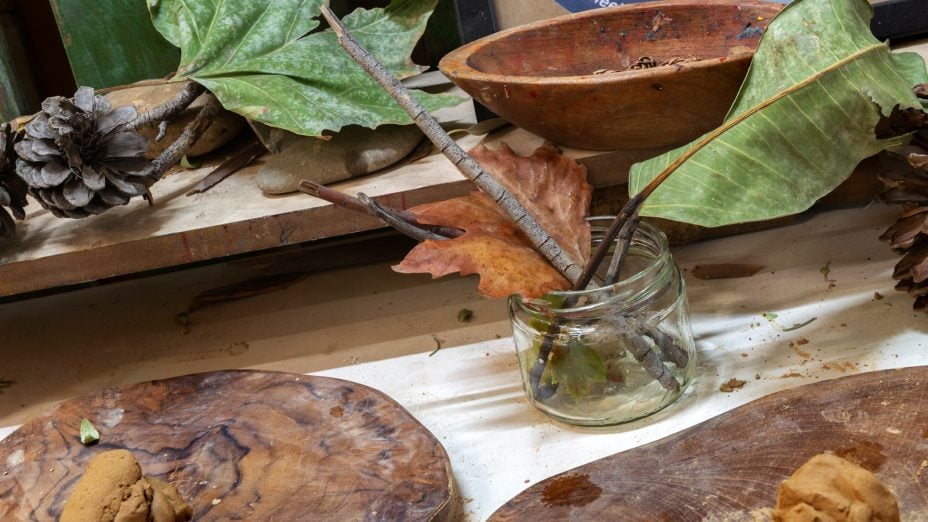
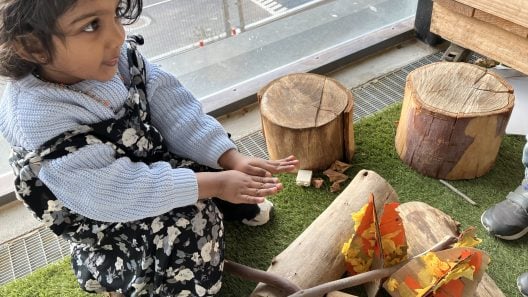
Gowrie @ The Harbour, in partnership with the Centre for Community Child Health, recently welcomed the Polyglot Theatre to the service for a week of interactive experiences that explored how children understand nature, feel empathy for non-human life, and experience their early learning environment.
Three separate experiences were set up for the children which would allow them to express their creativity—Big Draw, Paper and Tape, and Voice Lab.
In the “Big Draw” session, children responded enthusiastically as their drawings reflected rich imaginative storytelling and environmental awareness, from trees and birds to volcanoes and even a zombie playfully disrupting a bird’s nest.
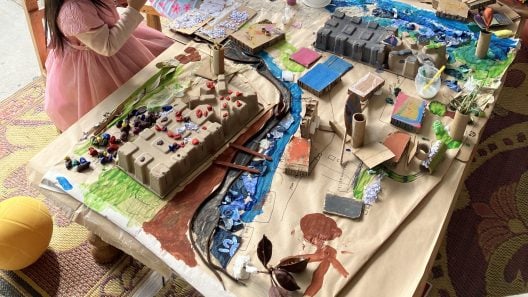
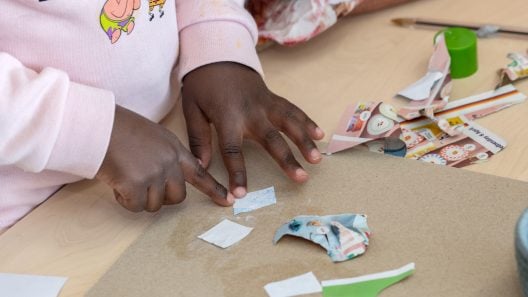
Another activity, “Paper and Tape”, invited the children to build a forest by collaborating with one another. They crafted butterflies, trees, a sun, and fire, showing a clear understanding of ecological needs like the sun for survival. One powerful moment of non-verbal expression came when a child, after creating a tree, carefully added a river and gently placed the tree’s roots into the water, demonstrating an unspoken understanding of ecosystems with empathy.
In the other activity, “Voice Lab”, a special dome was installed where children participated in deeper conversations.
The lab highlighted how different environments can affect children’s expression. Interestingly, some children who were usually very chatty became quiet inside the dome, while more reserved children became expressive. This emphasised the importance of offering children multiple and varied ways to express themselves, both verbally and non-verbally. The conversations were insightful, including one child who, when asked about friendship, said, “I’m the boss of my body,” a wonderful reflection of their strong self-awareness and agency.
The week offered deep insights into the children’s connection to nature. They showed strong knowledge of how to plant and nurture seeds and expressed a desire to protect animals, though they were sometimes unclear on how to do so which opens up a potential opportunity for future learning.
From the quiet focus in the Voice Lab to the collaborative energy of educator-led activities, the project underscored the importance of listening to children in creative ways.
In reflecting on the experience, our Perrin Room ECT, Judy, highlighted setting clear expectations with children when introducing new materials as a key takeaway. She appreciated how the Polyglot team modeled safe and respectful use, supported by visual cues. Judy noted the intentional planning behind each experience, carefully considering guiding questions, demonstrations, and desired learning outcomes. She also valued how children’s voices were actively listened to and used to inform planning. From a teamwork perspective, Judy emphasised the benefit of clear communication around roles, supervision, and collaboration with other rooms to ensure smooth transitions and shared responsibilities.
Observing and participating in the Polyglot experiences supported our ECTs and educators to enhance their practice around the creative arts and intentionally using these experiences to elicit valuable responses from children, which then inform future teaching.