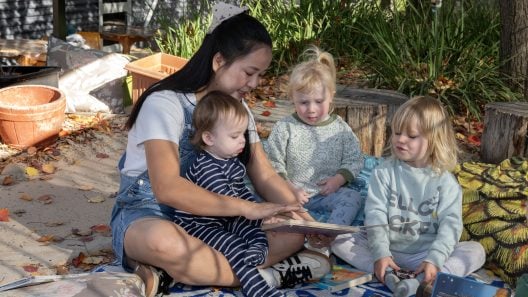
Encouraging language learning in early childhood is at the heart of everything we do at Gowrie. Language goes beyond just communication to building connections, respecting diversity, and supporting every child to feel seen and valued.
Many children who attend Gowrie services come from different cultures, each with their own distinct languages and forms of communication. Our educators and staff reflect this diversity as well, with many fluent in different languages. This can make communication with the child and their family easier.
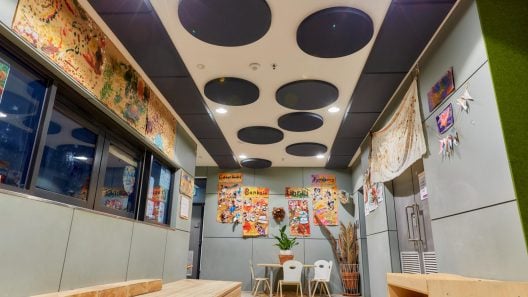
In the services, you’ll see signs, notices, and posters in different languages. But our commitment to inclusive language goes even further with educators at each of our services running programs that encourage children to explore languages.
Language as cultural identity
At our Broadmeadows Valley service, Bassima the Language Program Teacher, has been running Arabic language sessions for the children for the past four years.
Speaking about the language program, Bassima highlights the importance of maintaining Arabic language skills among children from Arabic-speaking backgrounds. “Teaching the children Arabic helps them connect with their heritage, communicate with family members, and build stronger connections with the wider Arab community. This fosters a sense of identity and belonging,” she says.
Learning Arabic not only deepens children’s understanding of their cultural traditions, but it also supports cognitive development by enhancing memory, problem-solving, and multitasking skills.
Complementing this focus on language and communication, educator Mikaela (also based at Broadmeadows Valley) can sign in both Key Word Sign (KWS) and Auslan. With the recent acknowledgement of the International Day of Sign Languages, Mikaela reflected on the importance of supporting children, families, and community members who may be Deaf or hard of hearing (HoH), as well as advocating for broader inclusion within the disability community.
What makes this approach especially inclusive is the collaboration between Bassima and Mikaela. When they are teaching together in the same room, Bassima focuses on Arabic while Mikaela simultaneously integrates KWS into the learning experience. Even when they are teaching separately, they both embed their respective languages into the children’s programs. This consistent, dual-language approach fosters inclusive communication practices from an early age.
This practice of connecting children to language and identity extends across Gowrie, with a significant focus on First Nations languages and perspectives. Embedding these languages into our programs is also helping to revitalise and sustain them for future generations. As Early Childhood Educator Audrey from Carlton North says, it’s important for us all that we continue learning First Nations languages as many are unfortunately endangered. One of the ways this is embedded at Carlton North is through the Acknowledgement of Country, which is also delivered in KWS. This has been well received by families, with one parent saying, “Our child showed us how Gowrie does the Acknowledgment of Country here, and he was so proud of showing us—it was wonderful!”
Carlton North’s Acknowledgement of Country:
“From the ‘ngua’ (sun) in the sky,
To the ‘biik’ (land) where we stand,
We say thank you,
to the Wurundjeri People,
for caring for the ‘biik’,
on which we play”
The multicultural fabric of our services provides rich opportunities for further language exploration. Also at Carlton North, Educator and Tagalog Language Teacher Martina engages the children with songs, stories, and playful experiences that encourage them to decode new sounds, recognise patterns, and use multiple modes of learning. “I integrate the language into everyday routines and use visual guides, gestures, and eye contact, helping children understand and communicate meaningfully,” she explains. Similarly, at The Harbour, Language Program Teacher Hanny has been running Indonesian lessons and has seen the profound impact on children’s confidence and family connections. “There’s a child here from an Indonesian family who mostly speaks English at home, so he’s quite shy about using Indonesian with other children at Gowrie,” says Hanny. “But his family has noticed that the Indonesian lessons are helping him feel more confident when speaking with his grandmother at home.”
Stories like this show how language learning at Gowrie is about helping children build identity, strengthen family connections, and feel proud of who they are.
This everyday integration is also evident at Docklands Kindergarten, a culturally and linguistically diverse community where educators and children learn greetings and names for food in languages like Hindi, Arabic, Mandarin, French, and Spanish. The service also has a range of books in different languages, and Educator Chiho likes to read Japanese stories while sounding out the pronunciation of the words. Stories like these show how language learning at Gowrie is about helping children build identity, strengthen family connections, and feel proud of who they are.
At Clare Court, ECT Clara runs the Italian Language Program, as many families at the service have Italian heritage, but is also an opportunity for other children to be exposed to a language they’re unfamiliar with. The program encourages problem-solving as the children form connections between spoken words, body language, and objects in their environment. “In the past few weeks, I have been focusing on a food inquiry, which allows children to explore the universal connection between humans and food, further enriching their learning and appreciation of different cultures,” explains Clara.
Beyond cultural immersion, our programs are also designed to build strong foundational literacy skills using innovative methods. At our Carlton Learning Precinct, the Early Language and Literacy Program supports children with tools like ‘Tommy Turtle’—a colourful map that helps them learn how to form both English and Arabic letters. “The map includes visual cues like landmarks and colours, giving children an internal dialogue to follow as they draw,” explains ECT Justen. “It’s more effective than simply tracing letters.” The program also uses sentence cycles and phonetic exercises where children explore how their mouths form specific sounds, building strong early literacy foundations in a fun, memorable way.
Language at Gowrie is embedded in every play corner, group time, and shared moments. Creating environments rich in language learning nurtures children’s capacity for confidence, empathy, creativity and identity. It reminds us that every child’s background, language and voice is seen, heard and valued.
Explore Related News
Discover more ideas, stories and sector insights
Explore more news, stories and updates from across Gowrie Victoria, including insights from our early learning communities, professional learning, training and sector partnerships.
Senior secondary students from 13 government schools spent five weeks finding out what a career in early childhood education looks like day to day, through the second phase of the Introduction to Early Childhood for School Students program.
In July, a child in the Room 1 at our Gowrie Docklands Kindergarten site asked the educators why they can’t have real fire at the service. Rather than shutting the idea down, educators used it as a starting point for a longer project.
Earlier this year our Carlton Learning Precinct (CLP) service received a Victorian School Building Authority grant to address acoustic issues in the outdoor areas and the kitchen corridor, where excessive noise had made it challenging for our children and educators to communicate.
The first years of a child’s life shape how they learn for years afterwards. Neuroscience calls this window before school a sensitive period of brain development, and research backs this up.
The Gowrie Victoria website is not compatible with Internet Explorer. Please use a modern browser such as Chrome, Firefox, Edge, or Safari for the best experience.