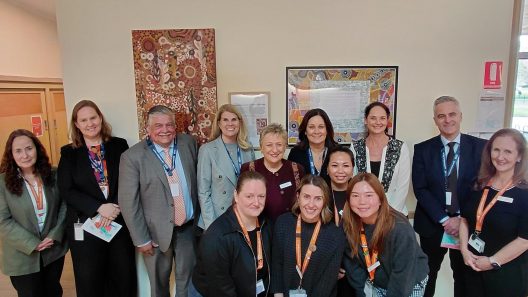
Last Thursday, Gowrie Victoria CEO Karen Weston joined Catharine Hydon from Hydon Consulting and Professor Tricia Eadie from the University of Melbourne for the latest session in the Best Start, Best Life Evening Leadership Series.
The focus of the forum was on maintaining quality through change, in which Professor Eadie spoke to the evidence developed here and overseas regarding ‘process’ quality and how important interactions are to children’s learning. Karen’s comments were about how leaders can support their teams through change and in improving ‘process’ quality. The panel discussed the Victorian Department of Education’s Teaching Excellence approach and the supports being introduced such as the Kindergarten Learning Progressions, practice support, professional learning and the Early Learning Hub.
The Teaching Excellence approach is about strengthening educator practice through consistent, evidence-informed tools and shared understandings of how children learn and develop. The Teaching Excellence approach means that the state government understands ‘process’ quality and is supporting educators to dedicate professional time to their learning, the use of evidence-based research and tools for educator capacity building that will improve outcomes for children and their families.
“It’s great to be in a place where the discussion is about quality, and where we as leaders in early learning have permission to talk about pedagogy, interactions and relationships,” Karen says. “We’re fortunate to have so much investment in tools which will make a tangible impact in children’s lives.”
As time with children expands for three- and four-year-olds, so too does our responsibility to ensure that this time is underpinned by high-quality, intentional practice and learning.
It’s insightful to have so much research around children and how they learn emerging over the past decade. Karen was reflecting with Emeritus Professor Iram Siraj recently on what is ‘emergent curriculum’ and how this work highlights an interesting shift towards recognising that while children lead learning through play, educators play an active and intentional role in extending that learning and the curriculum that emerges. “The VEYLDF has always highlighted the importance of integrated approaches to teaching and learning,” Karen says, “and the triple helix encourages child-directed play and learning, educator-led learning and guided play and learning. Educators always have a role in supporting children’s learning—we don’t always have to let the children lead.” This aligns with a growing body of research that positions educators not as passive observers, but as skilled professionals who intentionally guide, scaffold and deepen children’s thinking with an emphasis on interactions, deep pedagogical thinking and what we teach.
The recent publication of the Victorian Kindergarten Learning Progressions highlights the idea that children’s learning progresses in ways that educators should be able to identify, support and extend. When we can identify where children’s learning is at, and what might come next—that’s where meaningful opportunities emerge. In practice, this gives educators a clearer and shared language to describe learning, and greater confidence in making decisions about when to step in, extend or simply observe.
The creation of the Early Childhood Learning Hub provides free, evidence-based and self-paced learning to support professionals at all stages of their careers. This, coupled with learning about the Early Years Learning and Assessment Tool (EYALT) and the Victorian Kindergarten Learning Progressions means that these new tools can be explored, understood and reflected on before being embedded into practice.
Together, the Early Childhood Learning Hub, EYALT and the Learning Progressions form a connected system, where educators are supported to talk about children’s learning, observe, assess and plan with greater clarity and consistency.
Karen calls on leaders to reflect on how these supports can be utilised within services. “We know that high-quality professional learning is more likely to create sustained change when it’s coupled with time to challenge what we know, collaborate, reflect, and share learnings,” she says. She recommends promoting shared time together where teachers and educators can think and talk about each child’s individual learning. Karen also suggests focusing on one domain at a time within the Learning Progressions, developing a clear understanding of its intent and how it translates into everyday practice.
The continuation of the Learning Networks supports this learning too, creating space for shared dialogue and professional growth. EYALT offers a structured way for educators to document, interpret and respond to children’s learning in alignment with the Learning Progressions.
As evidence emerges, it’s worth remembering that this is not about getting everything right straight away. The introduction of new tools and approaches can feel significant, but meaningful change happens over time. By starting small and taking the time to question, reflect and collaborate, educators can build confidence and begin to see how to make a genuine difference in practice and in children’s learning and development.
Best Start, Best Life Evening Leadership Series | vic.gov.au
Read more articles with Karen Weston
Read more: Gowrie CEO Karen Weston Reflects on 2025
Read more: CEO Karen Weston on Child Safety in Early Childhood Education